Groundwater Modeling Software in India
Smart Bhujal is an authorised reseller of Aquaveo's groundwater modeling software in India, so an Indian team can license GMS here rather than buying it abroad. Aquaveo develops GMS. We resell it, and we run it.
What is GMS, the Groundwater Modeling System?
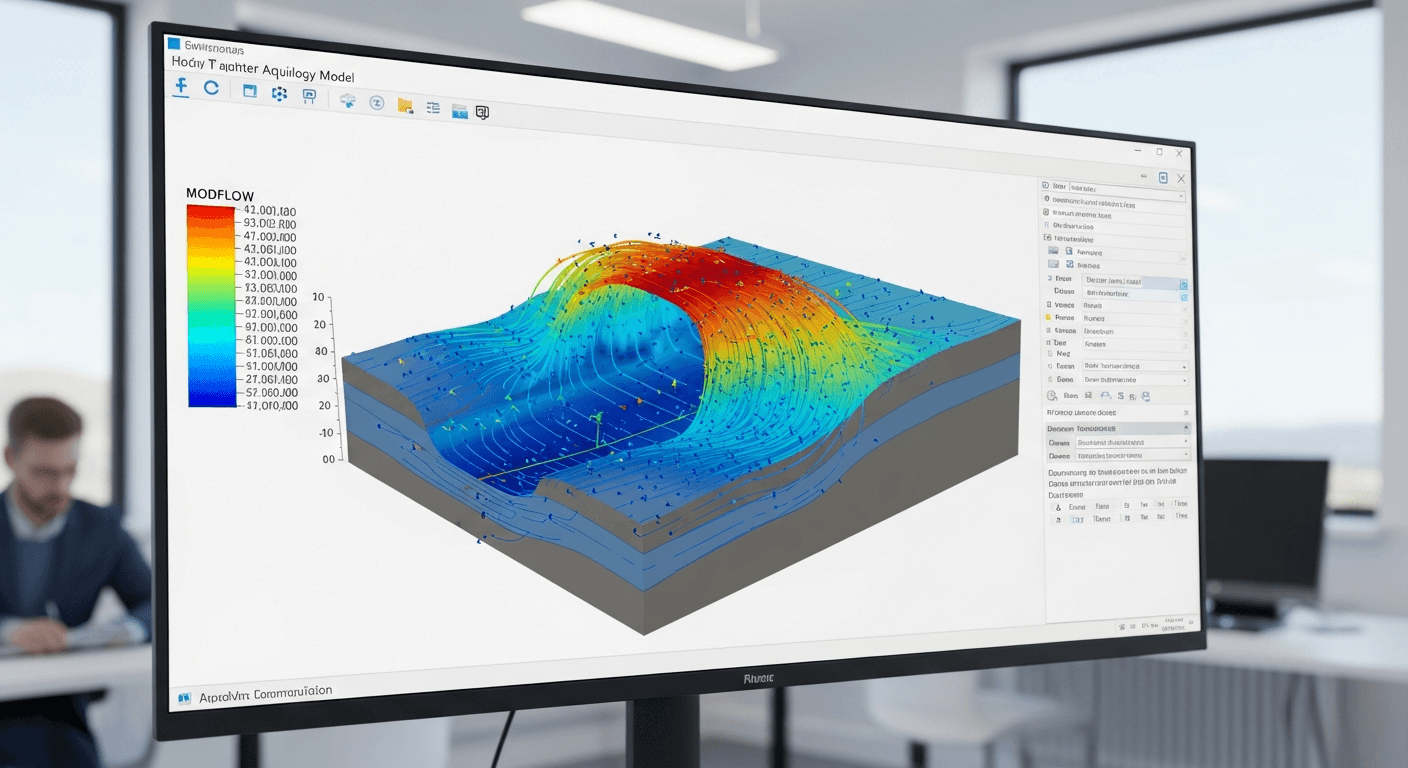
GMS is Aquaveo's groundwater simulation environment: one place to build the conceptual model, run MODFLOW and handle contaminant transport. That combination is what most groundwater work in India actually needs, because a flow model and a plume assessment are usually the same project asked twice.
Conceptual model first
Geology, aquifer layers, recharge zones, boundaries and existing abstraction are assembled before any grid is built, because a numerical model only ever encodes the conceptual understanding it was given.
Groundwater flow with MODFLOW
MODFLOW is the modular finite-difference groundwater flow model developed by the US Geological Survey. It is the most widely used groundwater model in the world because it is scientifically validated, well documented and accepted by regulatory agencies.
Contaminant transport
Groundwater models simulate contaminant movement once the flow model is coupled with a transport code such as MT3DMS. Those results are what a plume assessment, a remediation option study or a risk case to a water supply is argued from.
Calibration against real records
Calibration adjusts hydraulic conductivity, storage and recharge until simulated levels and flows reproduce the observed record. Automated tools such as PEST are used alongside manual adjustment, and the remaining error is reported rather than hidden.
Capture zones and wellfield design
Particle tracking delineates the area from which groundwater flows to a pumping well, which is how wellhead protection areas are set and how well spacing, depths and rates are checked for interference.
Yield, dewatering and river interaction
The same model answers sustainable yield, dewatering design for construction and mining, and how pumping changes the exchange between an aquifer and the rivers connected to it.
Licensing Aquaveo GMS in India
Smart Bhujal is an authorised reseller of Aquaveo's groundwater modeling software in India, which means an Indian buyer can license GMS through an Indian company. To be plain about the relationship: Aquaveo develops GMS and we are their authorised reseller here, not their developer.
We do not publish prices, licence options or terms on this site. Tell us how many users you need, which modules you are considering, and whether the licence is for a university, a consultancy or a government agency, and we will come back to you on the options.
Aquaveo's range extends beyond groundwater. It also includes WMS, the Watershed Modeling System, for watershed and drainage analysis, and SMS, the Surface-water Modeling System, for surface water modelling. Our reseller agreement is for the groundwater modeling software, so if WMS or SMS is what you are after, ask us and we will confirm what can be arranged rather than let you plan around an assumption.
Licence the software, or commission a modelling study?
The choice comes down to who runs the model after the first project ends. If flow and contaminant transport modelling is going to repeat, license the software. If you need one plume assessment or one wellfield study, a study is usually faster and cheaper, because most of the effort goes into the conceptual model, the site data and the calibration rather than into the licence.
License the software when
Buying a licence makes sense when the modelling capability has to outlive the project that paid for it.
- Groundwater flow and contaminant transport modelling is a repeating part of your work rather than a one-off.
- You have hydrogeologists in house, or you are building that team now.
- You want the conceptual model, the flow simulation and the transport work in one environment your own staff control.
- You intend to run and sign off studies in your own name.
Commission a study when
A study is usually faster and cheaper when the question is finite and the model has no life after it is answered.
- You need one plume assessment, one wellfield design or one dewatering scheme.
- The deliverable is for a regulator or a site closure rather than an ongoing capability.
- Most of the effort is the conceptual model, the site data and the calibration rather than the software licence.
- Nobody on your side would keep the model alive once the project closes.
What we will not do is sell a licence to somebody who has one model to build and no intention of building another. If a study is the right answer we will say so. Our study work is described under groundwater modeling services, and the wider scope sits under water consulting and modeling services.
How a groundwater modelling study runs
If you commission the study rather than license the software, this is the sequence. It is also a fair description of the work a licence puts in your own hands, since GMS is the environment our modellers use for it.
Frame the aquifer question
A wellfield, a plume and a dewatering scheme need different boundaries, grids and calibration targets.
Build the conceptual model
Geology, layers, recharge, boundaries and existing pumping, assembled first.
Reconstruct the hydrographs
Logger gaps and step changes repaired so they do not become false calibration targets.
Calibrate MODFLOW
Conductivity, storage and recharge fitted to observed heads, with the remaining error reported.
Predict the new stress
The proposed pumping or dewatering simulated, since it has no history to learn from.
Hand over the operating rule
A sustainable yield, well spacing or dewatering schedule, plus the monitoring to check it.
Who you are buying from
Smart Bhujal is a water consultancy incubated at IIT Tirupati, founded by doctorates in hydraulics and water resources and in machine learning. We resell GMS because it is the software our own modellers work in, not because it was a catalogue we happened to pick up.
Doctorate in hydraulics and water resources
From IIT Tirupati, with senior consulting work for the International Water Management Institute behind it.
Doctorate in machine learning
From IIT Tirupati, previously at Qualcomm, covering the deep learning and edge AI side of the work.
Incubated at IIT Tirupati
Smart Bhujal is incubated at the IIT Tirupati Technology Business Incubator.
A working modelling practice
We build calibrated groundwater models in MODFLOW, FEFLOW and GMS ourselves, so GMS is the environment our own modellers work in.
Groundwater modelling software: common questions
What Indian buyers ask before they license a groundwater modelling package or hand the modelling out.
Yes. Smart Bhujal is an authorised reseller of Aquaveo's groundwater modeling software in India, so GMS can be licensed through an Indian company rather than purchased overseas. To be plain about the relationship: Aquaveo develops GMS and we are their authorised reseller here, not their developer. We do not publish prices or licence options on this site, so tell us how many users you need and which modules you are considering and we will take it from there.
GMS, the Groundwater Modeling System, is Aquaveo's groundwater simulation environment. It is the usual answer when you want a single place to build the conceptual model, run MODFLOW and handle contaminant transport. In practice that covers aquifer characterisation and yield assessment, wellfield design, contaminant transport and remediation, dewatering design for construction and mining, and groundwater to surface water interaction.
Yes, contaminant transport is part of the work the Aquaveo partnership is built around. A groundwater model simulates contaminant movement once the flow model is coupled with a transport code such as MT3DMS, which is how you predict where a plume will travel, design a monitoring network, evaluate remediation options and assess risk to a water supply. Accurate transport modelling depends on good characterisation of aquifer properties, so the site data usually decides the quality of the answer more than the software does.
Both routes are open, and the choice mostly comes down to who runs the model after the first project ends. If flow and contaminant transport modelling is going to be a repeating part of your work, licensing is the sensible route, and GMS can be purchased through us. If you need one plume assessment for a regulator or a site closure, a study is usually faster and cheaper, because most of the effort goes into the conceptual model, the site data and the calibration rather than into the software licence. We do that study work in MODFLOW, FEFLOW and GMS. What we will not do is sell a licence to somebody who has one model to build and no intention of building another.
GMS is the usual answer when you want one environment for the conceptual model, MODFLOW and contaminant transport together. FEFLOW suits finite element problems where the geometry or the physics does not sit comfortably on a rectangular grid, since MODFLOW uses a finite-difference grid of rectangular cells while FEFLOW uses a triangular or tetrahedral mesh. If your job is one regional water balance, MODFLOW on its own may be all you need, and we will say so rather than sell you more.
Our reseller agreement is for Aquaveo's groundwater modeling software in India, which is why GMS is what this page is about. Aquaveo's wider range also includes WMS, the Watershed Modeling System, for watershed and drainage analysis, and SMS, the Surface-water Modeling System, for surface water modelling. If you are interested in either of those, ask us and we will confirm what can be arranged rather than let you plan around an assumption.
We do not publish prices, licence tiers or terms on this site. What a licence involves depends on how it is configured, so rather than guess at a figure on a web page, send us the number of users, the modules you are considering and whether the licence is for a university, a consultancy or a government agency, and we will come back to you on the options.
Groundwater modelling needs geological and hydrogeological data such as stratigraphy and aquifer properties, water level measurements, pumping records, recharge estimates and boundary conditions. Pumping tests provide crucial aquifer parameters. Buying software does not remove that requirement, and a thin dataset is the most common reason a model disappoints. We can work with existing data and recommend targeted field investigations to fill the gaps cost-effectively.
No, and the difference matters. GWPilot is our own web tool, on this site at /gwpilot, and it needs a sign-in. It pulls the public Central Ground Water Board groundwater level record for a state and district and turns it into level surfaces and seasonal outlooks for wells that are already monitored, which is useful for regional assessment and for screening an area before anyone commits to a study. It does not solve the groundwater flow equations, so it cannot tell you the drawdown from a wellfield that has not been drilled, or where a contaminant plume will travel. MODFLOW, FEFLOW and GMS exist for exactly those questions.
Related on this site
Tell us what you are modelling
Send us the number of users, the modules you are considering, and the aquifer question behind it. We will tell you whether a licence or a study is the better answer.