Groundwater Modeling
Aquifer Simulation & Groundwater Analysis

How We Can Help
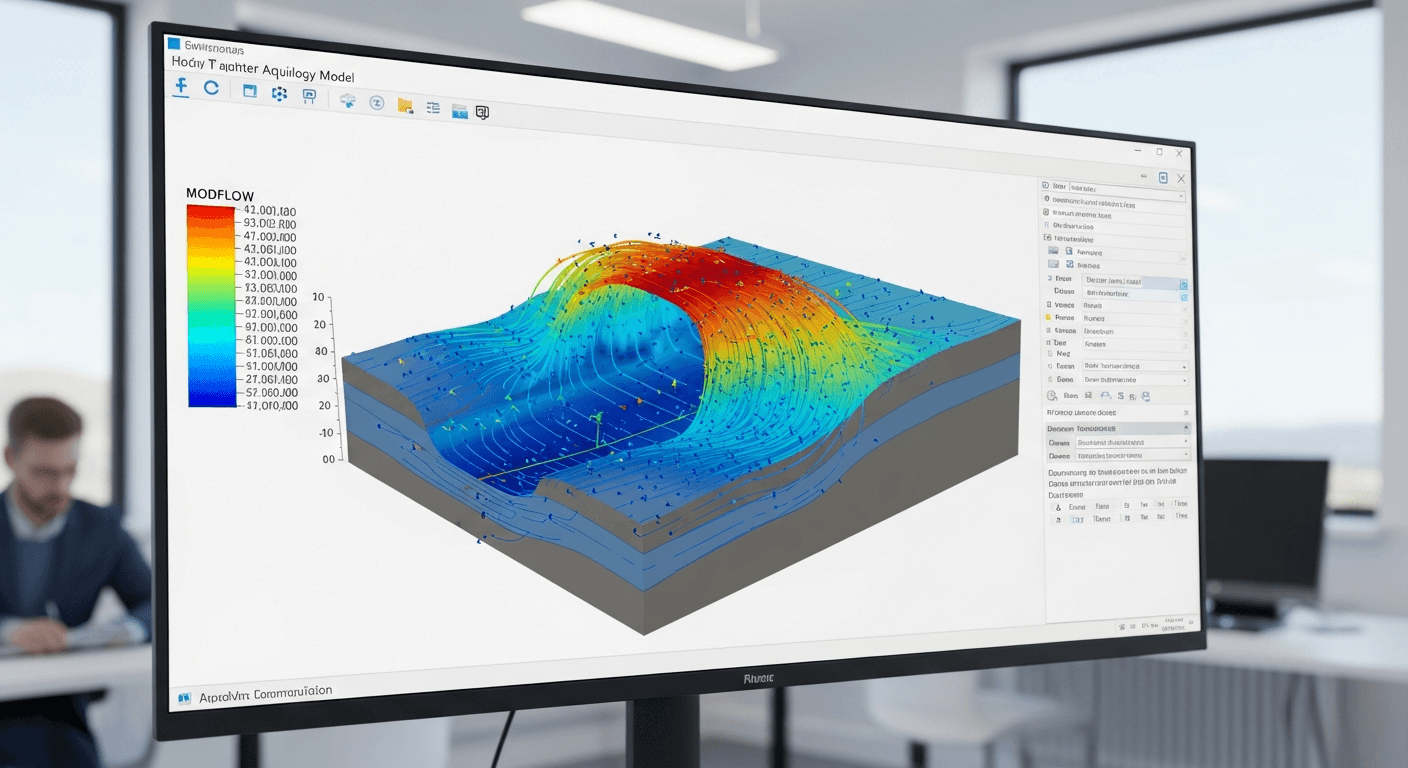
Groundwater is complex and invisible, but our modeling makes it understandable. Using MODFLOW and FEFLOW, we build calibrated models that accurately represent your aquifer system. Whether you're planning a new wellfield, assessing contamination risks, or designing dewatering systems, our models give you the confidence to make informed decisions. Machine learning has one precise role here and we hold it to that role. Observation well records are irregular, noisy and interrupted, so a learned model reconstructs the gaps and flags the readings that are logger artefacts rather than aquifer behaviour, which means calibration targets are honest rather than convenient. Where levels are monitored but no calibrated model exists yet, a forecasting model trained on those records with rainfall and pumping as inputs gives a useful seasonal outlook in the meantime. What it cannot do is answer the question a wellfield study asks, because a model trained on past hydrographs has never seen the wells you are proposing and has nothing to learn their drawdown from. MODFLOW does not need to have seen them, and that is the entire reason to build one. On the software side, Smart Bhujal is an authorised reseller of Aquaveo's groundwater modeling software in India, which covers GMS, the Groundwater Modeling System. So if you are looking to license a groundwater modeling package rather than commission a study, that is a conversation you can have with us directly, and GMS is the same environment our own modellers work in. Aquaveo develops GMS; we resell it here and we did not build it. Separately, GWPilot is our own web tool on this site: it pulls the public Central Ground Water Board groundwater level record for a chosen state and district and turns it into level surfaces and seasonal outlooks for wells that are already monitored. That is a screening and regional assessment tool, not a flow model, and it does not replace one.
How the model gets built
What a groundwater modeling study involves, from framing the question to the decision the calibrated model supports.
Frame the aquifer question
A new wellfield, a contaminant plume and a dewatering scheme demand different model boundaries, different grid resolution and different calibration targets. Getting this wrong wastes the whole build.
Build the conceptual model
Geology, aquifer layers, recharge zones, boundaries and existing abstraction are assembled first, because a numerical model only ever encodes the conceptual understanding it was given.
Reconstruct the hydrographs
Logger gaps and step changes are repaired before calibration, since an interpolated straight line through a missing monsoon becomes a false target that distorts the fitted conductivity field.
Calibrate MODFLOW
Conductivity, storage and recharge are fitted until simulated heads reproduce the observed record, and the remaining error is reported rather than hidden.
Predict the new stress
The proposed abstraction or dewatering is simulated, because an undrilled wellfield has no history to learn from and only the physics can extrapolate to it.
Hand over the operating rule
The client receives a sustainable yield, a well spacing or a dewatering schedule, plus the monitoring network that will show whether the aquifer behaves as modelled.
Software & Tools We Use
MODFLOW
USGS standard groundwater flow model
FEFLOW
Finite element groundwater simulation
Visual MODFLOW
Graphical groundwater modeling
GMS
Groundwater Modeling System
GWPilot
Our own web tool for regional groundwater level assessment from the public CGWB record. Sign-in required.
Applications
Aquifer characterization and yield assessment
Wellfield design and optimization
Contaminant transport and remediation
Dewatering design for construction/mining
Groundwater-surface water interaction
Hydrograph gap-filling and anomaly screening ahead of model calibration
Aquaveo GMS software licensing in India for teams running groundwater modelling in house
Regional groundwater level screening from public CGWB records using GWPilot
Frequently Asked Questions
MODFLOW is a modular finite-difference groundwater flow model developed by the US Geological Survey (USGS). It's the world's most widely used groundwater model because it's scientifically validated, freely available, well-documented, and accepted by regulatory agencies worldwide. We use MODFLOW for its reliability and the extensive support tools available.
A simple groundwater model for a small site can be completed in 4-8 weeks. Regional aquifer models with detailed calibration typically take 3-6 months. Complex models involving contaminant transport or variable-density flow may require 6-12 months. Timeline depends on data availability, model complexity, and calibration requirements.
MODFLOW uses a finite-difference grid (rectangular cells) while FEFLOW uses finite elements (triangular/tetrahedral mesh). FEFLOW is better for complex geology, irregular boundaries, and problems requiring high resolution in specific areas. MODFLOW is often preferred for regional models and regulatory submissions. We recommend the appropriate tool based on your project needs.
Groundwater modeling requires geological/hydrogeological data (stratigraphy, aquifer properties), water level measurements, pumping records, recharge estimates, and boundary conditions. Pumping tests provide crucial aquifer parameters. We can work with existing data and recommend targeted field investigations to fill data gaps cost-effectively.
Yes, groundwater models can simulate contaminant transport when coupled with transport codes like MT3DMS or FEFLOW's transport module. These models predict how contaminants move through aquifers, helping design monitoring networks, evaluate remediation options, and assess risks to water supplies. Accurate transport modeling requires good characterization of aquifer properties.
Model calibration adjusts aquifer parameters (hydraulic conductivity, storage, recharge) until simulated water levels and flows match observed measurements. We use automated calibration tools like PEST alongside manual adjustments, targeting both steady-state and transient conditions. A well-calibrated model provides confidence in predictions for planning and design.
Safe yield is the amount of groundwater that can be sustainably extracted without causing unacceptable impacts like water level decline, reduced baseflow, or land subsidence. We determine safe yield through long-term model simulations that balance recharge with extraction while monitoring impacts on dependent ecosystems and existing users.
Wellfield design involves simulating different well configurations (number, spacing, depths, pumping rates) to optimize yield while minimizing interference between wells and impacts on neighboring users. Our models evaluate drawdown, capture zones, and long-term sustainability to recommend the most efficient wellfield layout.
A capture zone is the area from which groundwater flows to a pumping well. Capture zone analysis uses particle tracking in groundwater models to delineate wellhead protection areas and assess contamination risks. This is essential for protecting drinking water supplies and designing monitoring networks around production wells.
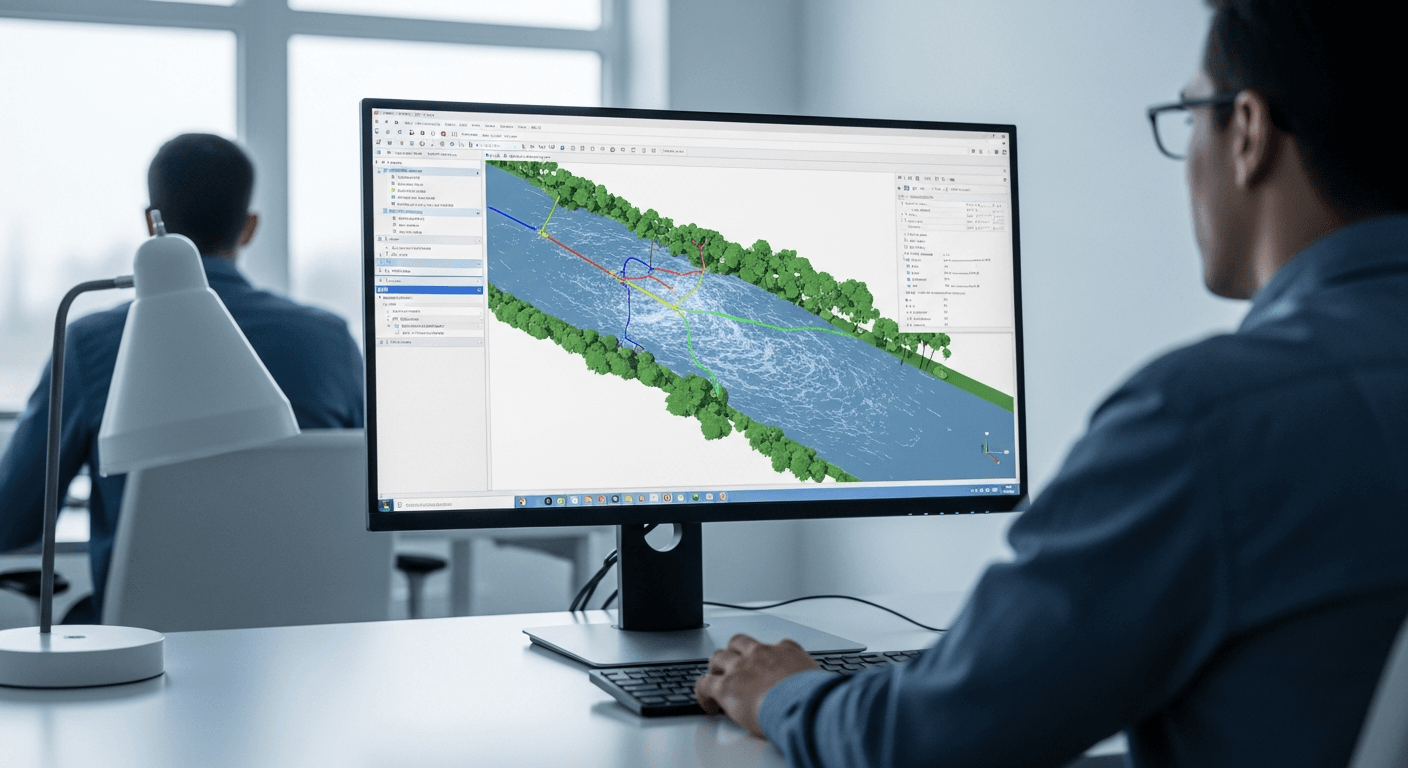
Groundwater and surface water are interconnected - rivers may gain water from aquifers (gaining streams) or lose water to aquifers (losing streams) depending on relative water levels. Our models simulate this interaction to assess impacts of pumping on streamflow, plan conjunctive use, and protect environmental flows.
It works on the data around the model, not on the flow simulation. Observation well hydrographs arrive with gaps, spikes and step changes caused by loggers failing, flooding or being reset, and a learned model reconstructs the missing stretches from neighbouring wells and rainfall so that calibration is matched against a complete record rather than a straight line drawn through a gap. The same models flag readings that are instrument artefacts rather than real aquifer response, which is the sort of thing that otherwise quietly distorts a calibrated hydraulic conductivity field. Spatial interpolation between monitored wells produces the level surfaces used for regional assessment, which is what our free GWPilot tool does on the public CGWB record. On prediction the division is strict. Forecasting the seasonal behaviour of a well that is already monitored suits a learned model well. Predicting drawdown from a wellfield that has not been drilled does not, because no historical record contains it, and that is precisely what MODFLOW is for.
GMS you can buy through us, because Smart Bhujal is an authorised reseller of Aquaveo's groundwater modeling software in India. On which package to use, GMS, the Groundwater Modeling System, is the usual answer when you want a single environment for building the conceptual model, running MODFLOW and handling contaminant transport, which is the work the Aquaveo partnership is built around. FEFLOW suits finite element problems where the geometry or the physics does not sit comfortably on a rectangular grid. If your job is one regional water balance, MODFLOW on its own may be all you need, and we will say so rather than sell you more. To be plain about the relationship: Aquaveo develops GMS and Smart Bhujal is their authorised reseller in India, not their developer. We do not publish prices or licence options on this page, so tell us how many users and which modules you are considering and we will take it from there.
Both routes are open, and the choice mostly comes down to who runs the model after the first project ends. If flow and contaminant transport modelling is going to be a repeating part of your work, licensing the software is the sensible route, and GMS can be purchased through us because Smart Bhujal is an authorised reseller of Aquaveo's groundwater modeling software in India. If you need one plume assessment for a regulator or a site closure, a study is usually faster and cheaper, because most of the effort goes into the conceptual model, the site data and the calibration rather than into the software licence. We do that study work in MODFLOW, FEFLOW and GMS. What we will not do is sell a licence to somebody who has one model to build and no intention of building another.
No, and the difference matters. GWPilot is our own web tool, on this site at /gwpilot, and it needs a sign-in. It pulls the public Central Ground Water Board groundwater level record for a state and district and turns it into level surfaces and seasonal outlooks for wells that are already monitored, which is useful for regional assessment and for screening an area before anyone commits to a study. It does not solve the groundwater flow equations. So it cannot tell you the drawdown from a wellfield that has not been drilled, or where a contaminant plume will travel, because neither of those appears anywhere in the historical record it learns from. MODFLOW, FEFLOW and GMS exist for exactly those questions.
Need Groundwater Modeling?
Get in touch with our expert team to discuss your modeling requirements.