Surface Water & Flood Modeling
River Hydraulics & Flood Analysis

How We Can Help
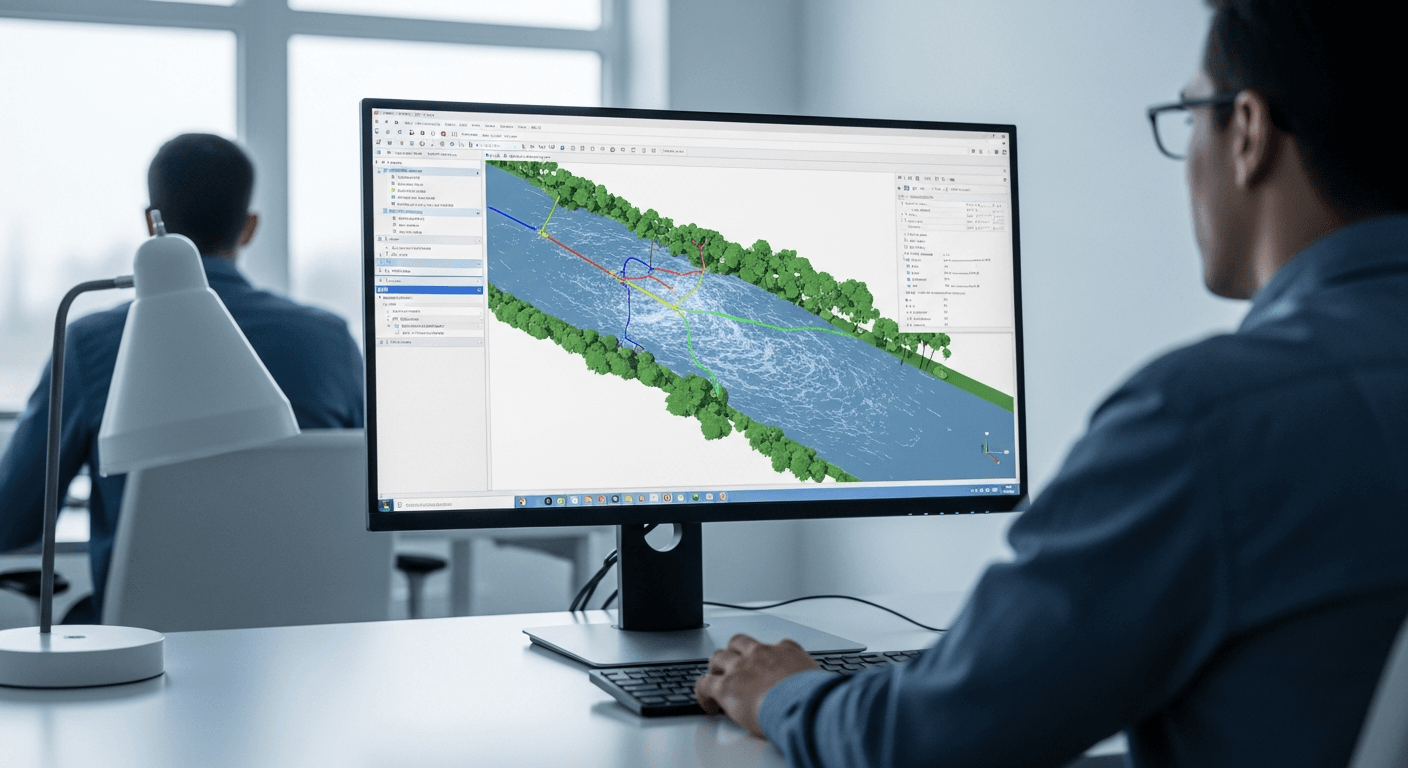
Our hydraulic engineers have decades of combined experience in flood modeling and river analysis. We use HEC-RAS, MIKE, and other industry-standard tools to deliver accurate simulations that inform critical infrastructure decisions. Whether you need flood hazard maps, dam safety assessments, or bridge hydraulic designs, we provide reliable results you can trust. Machine learning sits on either side of the hydraulic model rather than inside it. Ahead of it, forecast rainfall is bias corrected and gauge records are gap-filled so the model runs on the best inputs available rather than on whatever the telemetry happened to deliver. The hydraulics themselves stay with HEC-RAS, because a design flood is normally larger than anything in the record, and a learned model asked to extrapolate past its training range will answer confidently and wrongly. On software, a large part of this work needs no licence at all: HEC-RAS is free software from the US Army Corps of Engineers and, alongside HEC-HMS from the same centre for the rainfall-runoff side, it covers most river hydraulics studies, so we would rather point you there than sell you something. Where a commercial package genuinely is the right answer, note that Smart Bhujal is an authorised reseller of Aquaveo's groundwater modeling software in India. Aquaveo's own suite also includes SMS, the Surface-water Modeling System for 2D and 3D surface water modelling, and WMS, the Watershed Modeling System for watershed and drainage analysis, so if you want either of those, ask us and we will confirm what we can supply. Aquaveo develops all of it; we are a reseller, not the developer.
How the model gets built
What a surface water & flood modeling study involves, from framing the question to the decision the calibrated model supports.
Fix the flood question
A floodplain map, a bridge opening and a dam breach study need different reach lengths, different boundary conditions and different acceptance criteria. That choice governs everything downstream.
Build the terrain
Channel survey, LiDAR and structure geometry are assembled into the model terrain, because in a river reach the cross sections and the bridge soffit decide the answer more than any parameter does.
Repair the flow record
Gauge series are gap-filled and forecast rainfall is bias corrected against local observations, so the model is driven by a continuous record rather than a convenient assumption.
Calibrate to real floods
Roughness is fitted against observed levels from past events, since a hydraulic model that has never reproduced a flood that actually happened is an opinion with a mesh.
Run the design events
Design and extreme events are simulated in HEC-RAS. These are conditions no record contains, which is exactly why a learned model cannot be substituted for the hydraulics here.
Issue the map or threshold
The client receives a flood hazard map, a freeboard check or a warning level, with the calibration evidence and the assumptions stated alongside it.
Software & Tools We Use
HEC-RAS
USACE river hydraulics and flood modeling
HEC-HMS
Hydrologic modeling for watershed runoff
MIKE 11
1D river and channel flow simulation
MIKE 21
2D coastal and floodplain modeling
Delft3D
3D hydrodynamic and sediment modeling
Applications
Flood hazard mapping and risk assessment
Bridge and culvert hydraulic design
Dam break analysis and emergency planning
River restoration and channel design
Climate change flood impact studies
Machine learning bias correction of forecast rainfall and gap-filling of gauge records
Frequently Asked Questions
HEC-RAS (Hydrologic Engineering Center's River Analysis System) is a free software developed by the US Army Corps of Engineers. It's the industry standard for simulating water flow in rivers and channels, calculating flood levels, and mapping flood inundation areas. We use HEC-RAS because of its proven accuracy, regulatory acceptance, and ability to handle complex river systems.
Flood modeling typically requires topographic data (LiDAR or surveyed cross-sections), hydrologic data (rainfall records, streamflow measurements), land use information, and details of hydraulic structures like bridges and culverts. We can work with available data and recommend cost-effective surveys to fill any gaps.
When properly calibrated with observed flood data, HEC-RAS models typically achieve accuracy within 10-15 cm for water levels. Accuracy depends on data quality, model calibration, and the complexity of the river system. We always validate our models against historical flood events when data is available.
1D modeling simulates flow along a river channel and is faster and suitable for most river studies. 2D modeling simulates flow across floodplains in two dimensions and is better for complex urban areas, wide floodplains, or where flow paths are uncertain. We recommend the appropriate approach based on your project needs and budget.
A basic flood study for a small river reach takes 4-6 weeks. Comprehensive studies with detailed floodplain mapping for larger areas typically take 3-6 months. Dam break analyses and complex urban flood studies may require 6-12 months depending on scope and data availability.
A dam break analysis simulates the catastrophic failure of a dam to predict downstream flooding, warning times, and potential impacts. It's required for dam safety permits, emergency action plans, and downstream hazard classification. We use HEC-RAS to model breach formation and route the flood wave downstream.
The 100-year flood has a 1% chance of occurring in any given year. We determine it through statistical analysis of historical flood records or rainfall-runoff modeling when streamflow data is limited. The 100-year discharge is then routed through the hydraulic model to calculate corresponding water levels.
Yes, we incorporate climate change by adjusting rainfall intensities and sea levels based on climate projections. This allows assessment of future flood risks under different climate scenarios. Many jurisdictions now require climate change considerations in flood studies for infrastructure planning.
Both are industry-standard tools. HEC-RAS is free and widely accepted in North America, while MIKE (by DHI) is commercial software popular in Europe and Asia. MIKE offers more integrated modules for coastal and urban flooding. We're proficient in both and recommend based on project requirements and client preferences.
Flood maps delineate areas at risk of flooding for different return periods (10-year, 100-year, etc.). Planners use these to restrict development in high-risk zones, set building floor levels, design drainage infrastructure, and inform emergency response plans. Accurate flood mapping is essential for sustainable urban development.
Not for the flood that matters. A learned model interpolates within the range of events it was trained on, and the events that drive flood infrastructure decisions, the 100-year design flood and the dam break, sit by definition outside that range. HEC-RAS solves the flow equations, so it remains valid for an event nobody has ever recorded. Machine learning is genuinely useful at the edges of the same workflow: correcting the known bias in a forecast rainfall product before it enters the model, filling gaps in the gauge record the model is calibrated against, and, where an operational warning has to be issued in minutes but a full two-dimensional run takes hours, a fast approximation trained on that model's own outputs can stand in for it. Note that even then the physics defines the answer, because the physical model generated everything the approximation learned from.
Often the free tool is also the right tool, so start there. HEC-RAS is free software from the US Army Corps of Engineers, and with HEC-HMS from the same centre it covers river hydraulics, flood level calculation, inundation mapping and watershed runoff. HEC-RAS also carries the regulatory acceptance that matters when a flood map has to be defended. Move to a commercial package when something specific forces it, typically coastal or complex 2D and 3D work, integrated urban and river modelling, or a client standard you have to meet. On buying: Smart Bhujal is an authorised reseller of Aquaveo's groundwater modeling software in India, and Aquaveo's suite also includes SMS, the Surface-water Modeling System for 2D and 3D surface water modelling, and WMS, the Watershed Modeling System for watershed and drainage analysis, so ask us about those two and we will confirm what we can supply. MIKE 11 and MIKE 21 are DHI's commercial products and Delft3D comes from elsewhere again; we model in all of them and we sell none of them. Describe the study in front of you and we will tell you which of these you actually need, including when the answer is a free tool.
Need Surface Water & Flood Modeling?
Get in touch with our expert team to discuss your modeling requirements.