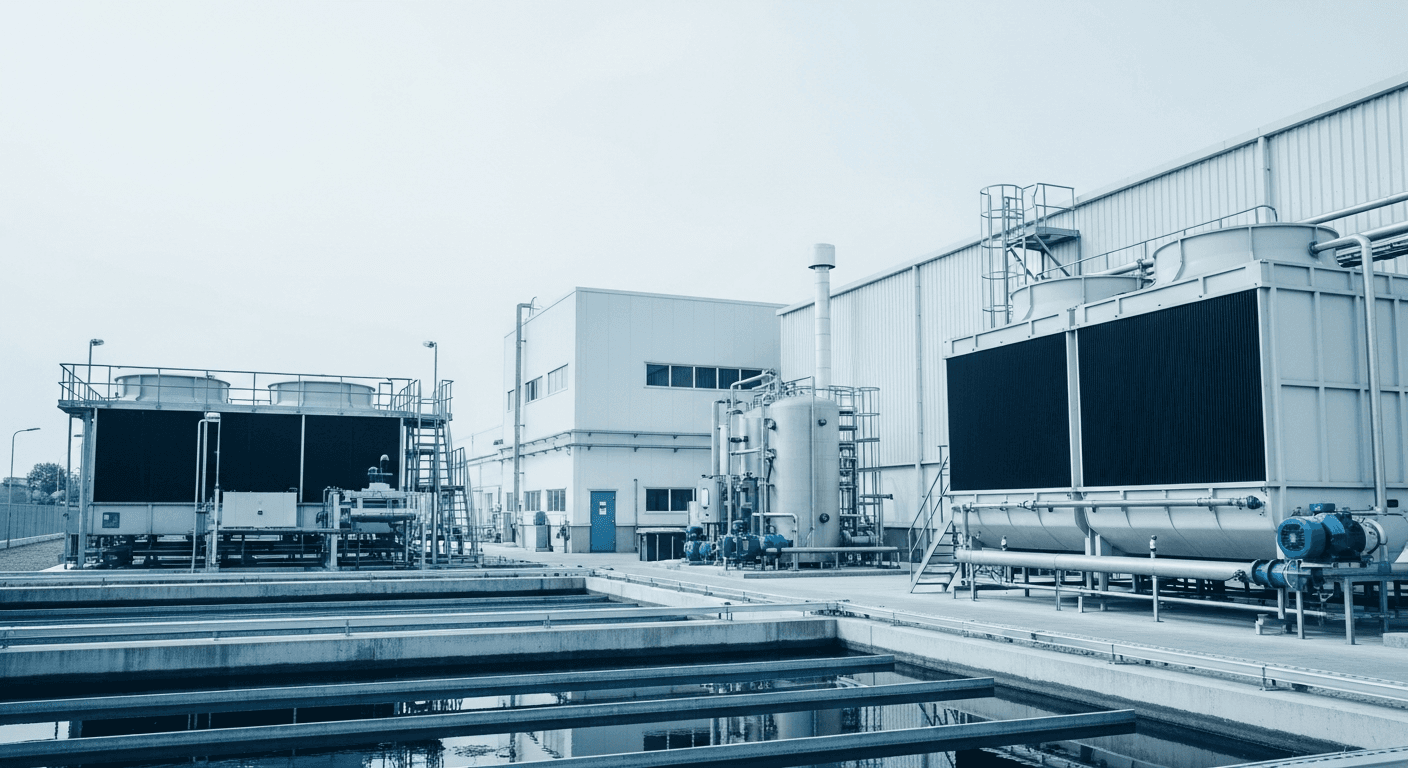
Industrial
Efficient Water Use for Manufacturing Excellence

How We Can Help
We help manufacturing facilities transform water from a cost center into a competitive advantage. Our solutions integrate seamlessly with your existing operations, providing real-time visibility into water usage, automated compliance reporting, and actionable recommendations for reducing consumption. From process optimization to wastewater treatment planning, we're your partner in achieving operational excellence and sustainability goals. Mass balance and process chemistry still decide how a treatment train is sized. Machine learning earns its place upstream of that, in the sensor data: models trained on your own flow, conductivity and pH history learn what a normal shift looks like on each process line, so a fouling membrane or a drifting analyser shows up as an anomaly well before it shows up in a compliance sample.
How the work runs
How a industrial engagement runs, from the decision that starts it to the one it hands back.
Name the binding constraint
A discharge consent, a freshwater reduction target and a recycling investment are three different problems. Which one is binding decides whether the answer is a treatment train or a metering programme.
Audit every stream
Intake, each process line, cooling, cleaning and every discharge point are metered and mapped, because a single incoming utility meter cannot tell you which process is the heavy user.
Close the mass balance
Measured intake is reconciled against measured discharge, evaporation and product moisture, so the unaccounted gap is a quantified number before any option is priced.
Learn the normal shift
Anomaly detection is trained on your own flow, conductivity and pH history so each process line has a baseline, and a fouling membrane or drifting analyser shows up as a departure from it.
Size the treatment train
Unit sizing and fit-for-purpose reuse quality come from mass balance and process chemistry, not from learned models, because a process you have not run yet leaves no history to learn from.
Commit the scheme
The plant signs off a reuse or treatment scheme with its compliance margin stated, and the same instruments then measure whether the built system behaves as designed.
Key Challenges
High water consumption in manufacturing processes
Wastewater treatment and discharge compliance
Cooling water management inefficiencies
Water quality monitoring requirements
Our Solutions
Real-time water usage monitoring and optimization
Automated compliance tracking and reporting
Cooling tower water management systems
Water recycling and zero liquid discharge planning
Machine learning anomaly detection on flow and quality sensor streams
Frequently Asked Questions
ZLD is a wastewater treatment process that recovers all water for reuse, leaving only solid waste. It's required in water-stressed regions or for industries with hazardous effluents. While capital-intensive, ZLD eliminates discharge permits, reduces water intake, and can recover valuable materials from wastewater.
Cooling tower efficiency improves through optimizing cycles of concentration, reducing drift losses, using side-stream filtration, and implementing proper chemical treatment. We analyze your cooling water chemistry and operations to identify opportunities for 20-40% reduction in makeup water requirements.
Critical parameters include pH, conductivity, total dissolved solids (TDS), hardness, chlorides, biological oxygen demand (BOD), chemical oxygen demand (COD), and specific contaminants relevant to your industry. Continuous monitoring ensures process efficiency and regulatory compliance.
Our water audits map all water sources, uses, and discharges across your facility. We measure actual consumption at each process, identify leaks and inefficiencies, benchmark against industry standards, and prioritize improvement opportunities by water savings, cost reduction, and implementation ease.
Water recycling treats and reuses wastewater for various applications. Quality requirements depend on end use: cooling water needs lower quality than process water or boiler feed. We design fit-for-purpose treatment systems that match recycled water quality to application requirements cost-effectively.
Compliance requires treating wastewater to meet permit limits before discharge. We help design treatment systems, establish monitoring programs, and set up automated reporting. Real-time monitoring with alerts prevents violations by identifying issues before discharge limits are exceeded.
Water and energy are closely linked in industry - pumping, heating, and cooling water consumes significant energy, while power generation requires cooling water. Optimizing one often improves the other. We analyze these connections to identify combined water and energy savings opportunities.
Proper water treatment prevents scaling, corrosion, and biological fouling that damage equipment and reduce efficiency. We optimize chemical dosing through real-time monitoring and automated control, often reducing chemical use by 15-25% while improving treatment effectiveness.
Membranes (RO, UF, NF, MBR) remove dissolved and suspended contaminants to produce high-quality process water or enable water recycling. We size and select membrane systems based on feed water quality, required purity, and operating costs. Proper pretreatment extends membrane life and reduces operating costs.
Cleaning optimization includes CIP (clean-in-place) system tuning, spray nozzle selection, water pressure optimization, and recovery of final rinse water for initial washing. For food and pharma industries, we ensure water savings don't compromise hygiene or product safety standards.
It helps most in the sensor data. Flow, conductivity, pH and level readings arrive continuously, and an anomaly detection model trained on your own history learns the normal daily and shift patterns of each process line well enough to flag a fouling membrane, a stuck valve or a drifting analyser before the problem reaches a compliance sample. Forecasting effluent load a day ahead lets a treatment plant adjust dosing in advance instead of reacting to an excursion. What machine learning does not do is size a treatment train or predict the behaviour of a process you have not run yet, because it has no examples to learn from. That work stays with mass balance, process chemistry and hydraulic calculation, and we are explicit about which of the two is answering a given question.
Ready to Transform Your Industrial Water Management?
Let's discuss how we can help you achieve your water efficiency goals.