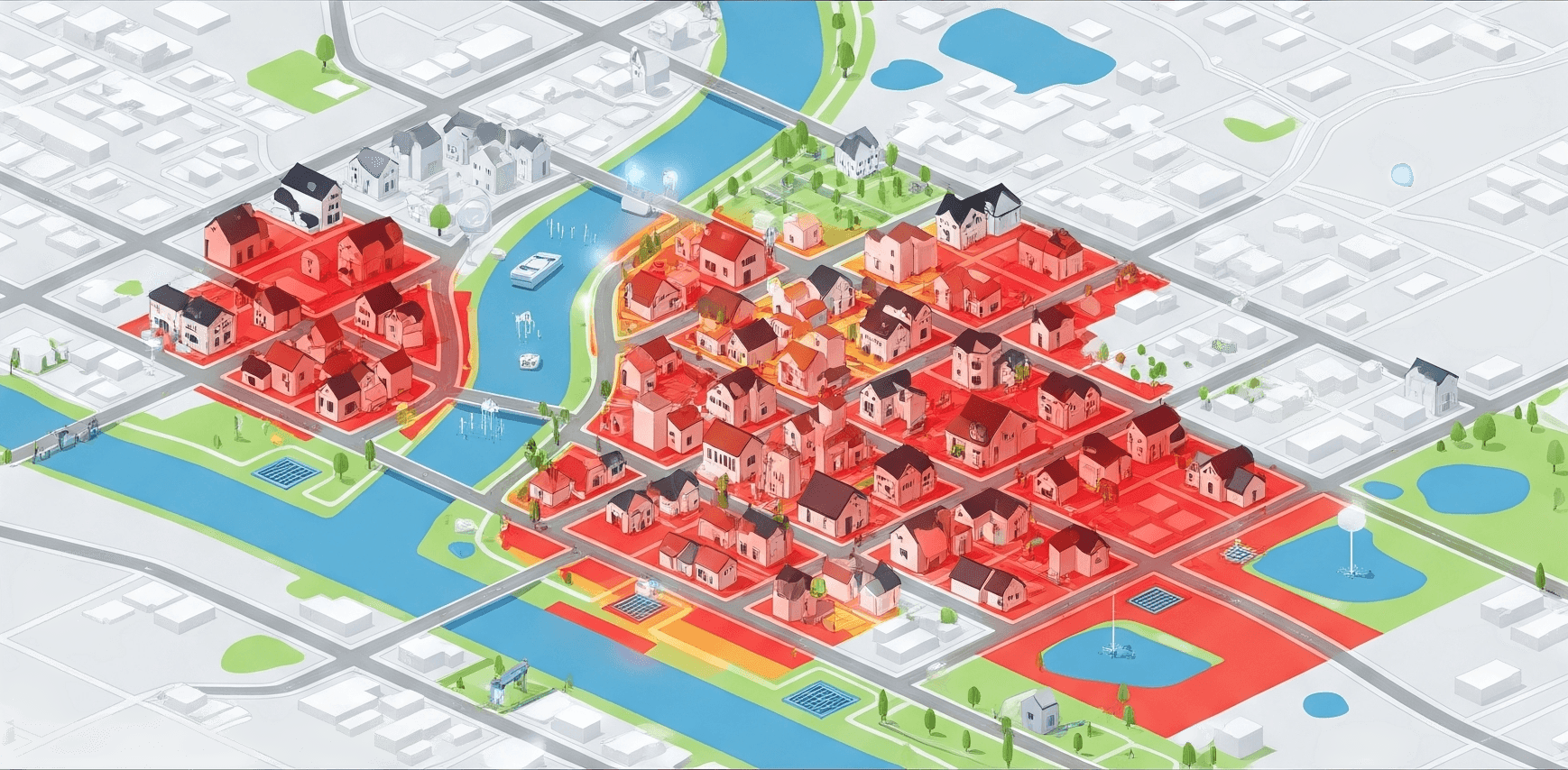
Start with HEC-RAS. It is free, it is the easier of the two to learn, and for most river and floodplain work it is all the model the problem needs. Move to DHI's MIKE suite when the river is heavily regulated, when the bed will move over the life of the works, or when the reach runs into an estuary.
The rest of this post is how to tell which of those situations you are in, because on raw hydraulics the two packages are closer than their users tend to admit.
What exactly is being compared?
HEC-RAS is a single program from the US Army Corps of Engineers Hydrologic Engineering Center. It does 1D steady and unsteady flow, 2D flow areas, coupled 1D-2D models, sediment transport, and bridge, culvert and weir hydraulics, with mapping in RAS Mapper.
MIKE is a family from DHI rather than one program. For rivers the relevant pieces are MIKE 11, the long standing 1D river engine, now run through the MIKE HYDRO River interface; MIKE 21 for 2D flow; MIKE 21C for river morphology; and MIKE FLOOD, which couples the 1D and 2D models. DHI is also consolidating its tools into the MIKE+ platform, so check which interface a current licence ships with before planning training around one.
So "HEC-RAS vs MIKE 11" is a 1D comparison, and "HEC-RAS 2D vs MIKE" usually means HEC-RAS against MIKE 21 or MIKE FLOOD.
Which is easier to learn?
HEC-RAS, by a clear margin, and the reasons are practical rather than technical.
- It costs nothing to practise on. Anyone can download it and build a model tonight. A MIKE licence has to be bought or requested, and DHI's free and educational options carry limits, so check the current terms.
- The learning material is enormous. The Corps publishes hydraulic reference, user and applications manuals with worked examples, and years of university courses, tutorials and forum answers are built on top of them. MIKE's documentation is good but comes mostly from DHI and its paid training.
- It is one program. A beginner learns one interface and one set of files. MIKE asks you to understand how several modules and set up files fit together before the first run.
A new modeller can usually have a 1D steady flow model running in HEC-RAS within a couple of days. The concepts transfer: cross sections, roughness, boundary conditions and 1D-2D coupling mean the same thing in MIKE, so time spent learning HEC-RAS first is not wasted if a project later needs MIKE.
Is one more accurate than the other?
Not in any way that should drive the choice. Both solve the shallow water equations with mature, widely validated numerical schemes. On a well posed river problem, a competent modeller gets comparable answers from either.
Accuracy comes from the terrain, the structure survey and calibration against observed floods. A calibrated HEC-RAS model beats an uncalibrated MIKE model, and the reverse is equally true.
Where does MIKE earn its licence?
- Heavily regulated rivers. Barrages, gated diversions, irrigation offtakes and reservoirs released by rule. Both packages model gated structures and operating rules, but MIKE 11's structure control is the more flexible where the operating rule matters as much as the channel.
- A moving bed. Where the question is how the channel will change over years, MIKE 21C is built for river morphology: bank erosion, bend migration, scour and deposition. HEC-RAS has 1D and 2D sediment transport, but for long term morphology on a large river MIKE is the more established tool.
- Rivers that meet the sea. Tidal reaches, estuaries and salinity intrusion sit naturally in the MIKE family, which shares its 2D engine with DHI's coastal models.
- Water quality in the same model. MIKE's ECO Lab adds user defined water quality processes to the hydrodynamics. HEC-RAS has a more limited water quality module.
- Client specification. Some agencies hold legacy MIKE models and ask for new work in the same package. That settles it regardless of preference.
Which should I use for permanent river engineering or a diversion?
It depends on what the design has to prove.
- Sizing a diversion channel or flood relief cut for design flows: HEC-RAS. Water levels, velocities and structure losses across a set of return periods is what it does best, and reviewers anywhere can rebuild the model.
- Flow splitting at a bifurcation or around a structure in plan: either package, in 2D. Model the junction in 2D rather than trusting a 1D flow split.
- Proving the new channel stays where you put it: this is the case for MIKE 21C or a dedicated morphological study. Permanent works last decades, and a channel that is hydraulically sound on day one can silt, scour or migrate. If the risk is the bed and banks rather than the water level, the morphology tool is the one that answers it.
- A gated diversion run by an operating rule: MIKE 11's control structures are the natural fit, though HEC-RAS rule operations can represent many of the same rules.
Temporary diversions during construction are usually a HEC-RAS job: a short design life, clear design flows, and a need to rerun quickly as the programme changes.
What about UK projects?
UK flood work is also commonly done in Flood Modeller from Jacobs, in TUFLOW and in InfoWorks ICM, and the Environment Agency does not as a rule mandate a single package. If the client is a UK authority, ask which package their existing models are in before choosing, because extending a model is usually cheaper than rebuilding it. We compare InfoWorks ICM and TUFLOW separately.
How do I decide in five minutes?
Ask three questions. Is the river controlled by structures with operating rules? Will the bed or banks move over the life of the works? Does the reach become tidal? Three noes mean HEC-RAS. Any yes is a reason to look seriously at MIKE, and the wider flood modelling comparison covers TUFLOW, Delft3D and the other free packages.
We work in both on surface water and flood projects and resell neither. Where a river model has to keep running after the study, for forecasting, reservoir operation or flood warning, it becomes a decision support system rather than a report.