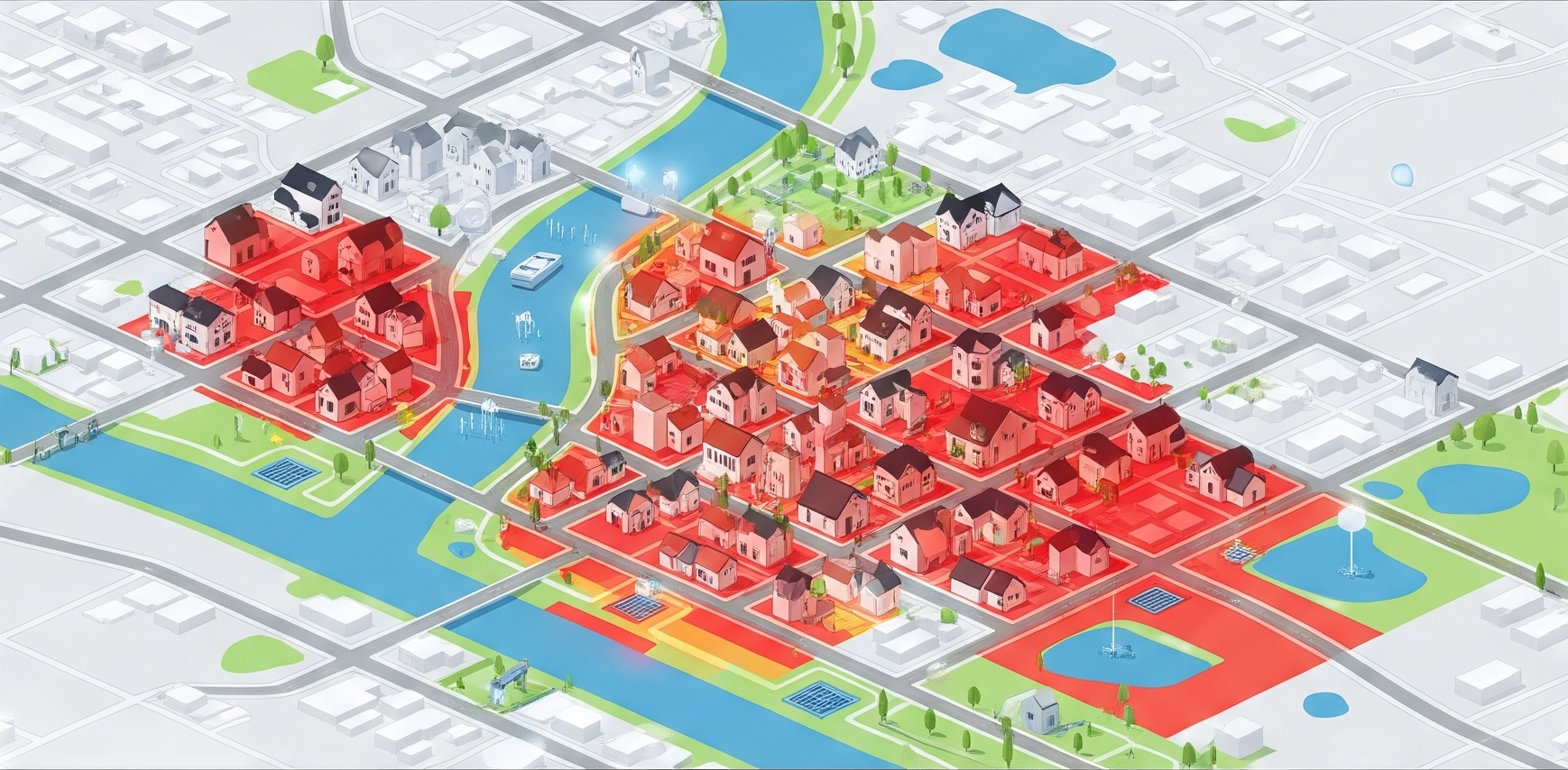
Autodesk's InfoWorks ICM and BMT's TUFLOW both solve coupled 1D and 2D hydraulics, and both appear on the approved list for major flood studies. Teams tend to hold strong views about which is better, which usually means each has been used on the kind of problem it suits.
What each assumes you are modelling
ICM assumes the drainage network is the subject. It was built outward from sewer and drainage modelling, it keeps the network in a managed database with version control and scenarios, and the 2D surface exists largely so that what leaves a manhole has somewhere to go. For an urban catchment where the pipes matter, this is the right shape.
TUFLOW assumes the floodplain is the subject. The 2D domain is the centre of the model, the 1D elements are there to carry culverts, bridges and channels through it, and the whole thing is driven by text control files over GIS layers. For a river reach, a breach study or a broad floodplain, that is the right shape.
The practical differences
- Model management. ICM keeps networks, scenarios and results in its own database, which is genuinely valuable when several modellers work on one system over years. TUFLOW models are files in folders, which means version control is whatever your team imposes, usually git or a naming convention.
- Transparency. A TUFLOW run is a set of readable control files, so a reviewer can see every assumption in a text diff. An ICM model is inspected through the application. Which you prefer says a lot about how your studies get audited.
- Compute. TUFLOW's HPC solver runs the 2D domain on GPU, which changes what a large fine resolution model costs in wall clock time. This matters most on the kind of study that reruns dozens of scenarios.
- Automation. Text driven models are straightforward to generate and batch from a script. That is a real advantage for ensembles, and it is the same argument we make about automating water network analysis.
Choosing
If the study is about a piped system and its interaction with the surface, ICM. If it is about a river, a floodplain or a breach, TUFLOW. If it is an urban catchment where surcharging drainage drives the flooding, ICM is usually the shorter road; if the same catchment is dominated by a watercourse passing through it, TUFLOW is.
Cost is the other axis, and it is the one that removes the choice for smaller teams. Both are commercial licences at a scale that a two person consultancy notices. We set out the alternatives for small teams separately, and the wider flood modelling comparison covers the free packages that cover a surprising amount of this ground.