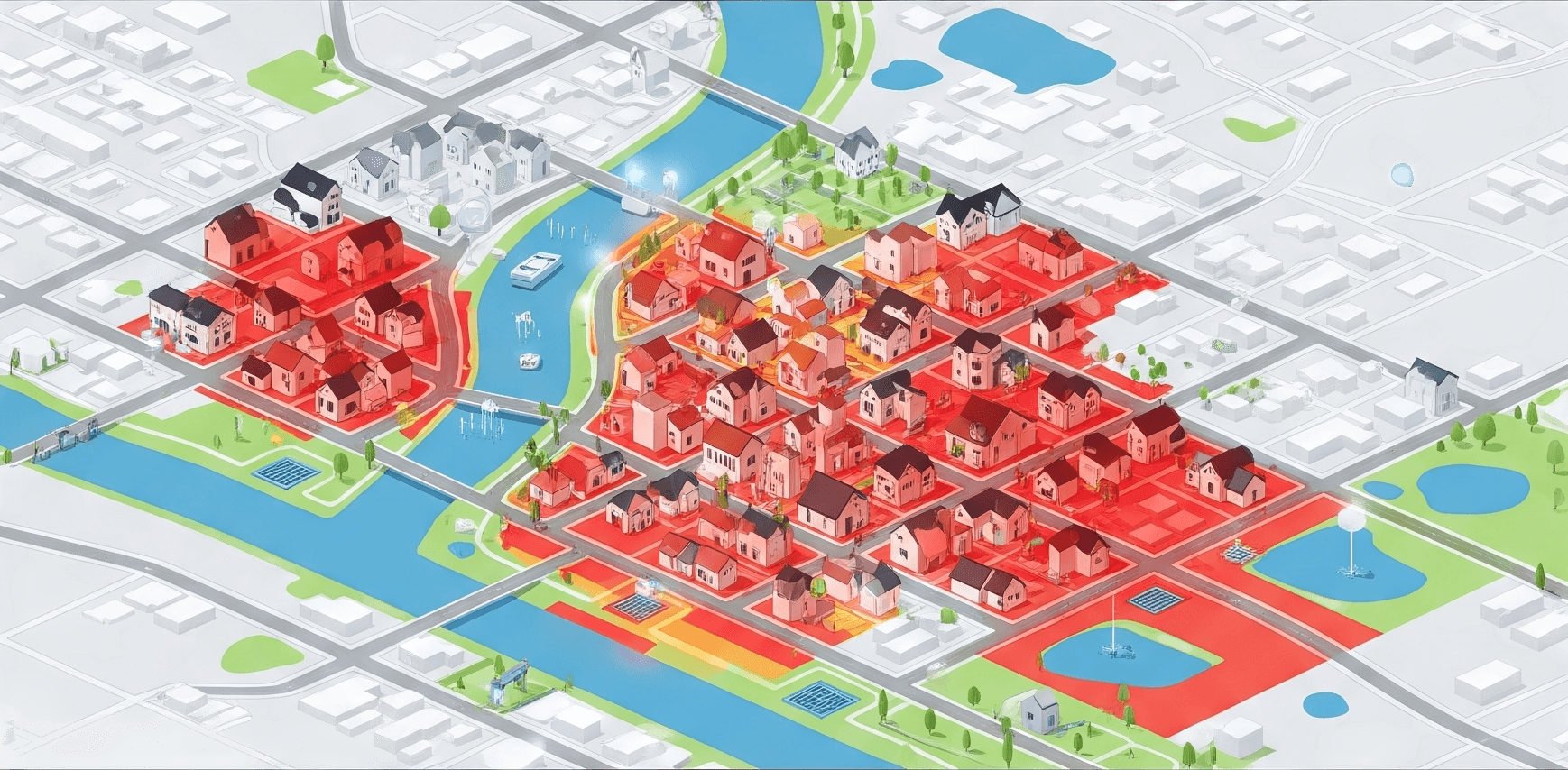
HEC-HMS works out how much water runs off a catchment and when it arrives. HEC-RAS works out how deep that water gets, how fast it moves and where it goes once it is in a river or on a floodplain. In short, HEC-HMS is hydrology and HEC-RAS is hydraulics. Both come from the Hydrologic Engineering Center of the US Army Corps of Engineers, both are free to use, and many flood studies run them in sequence, with the HEC-HMS hydrograph as the HEC-RAS inflow.
What is the difference between HEC-RAS and HEC-HMS?
The difference is the question each one answers. HEC-HMS answers "how much water, and when?" HEC-RAS answers "how high, how fast, and how far?"
| HEC-HMS | HEC-RAS | |
|---|---|---|
| Full name | Hydrologic Modeling System | River Analysis System |
| Discipline | Hydrology | Hydraulics |
| Main input | Rainfall and catchment properties | Terrain or cross sections, roughness, and flows at the boundaries |
| Main output | Flow hydrographs: runoff volume, peak flow and timing | Water levels, velocities and flood maps |
| How it moves water | Hydrologic routing along reaches you define | 1D and 2D unsteady flow equations |
| Run time | Short | Much longer for 2D |
What does HEC-HMS do, and what does it not do?
HEC-HMS simulates rainfall and runoff in a catchment. You split the catchment into subbasins, then choose methods for losses (such as SCS Curve Number or Green and Ampt), for turning excess rain into runoff (such as unit hydrographs), and for routing flow along reaches (such as Muskingum-Cunge). It can also handle reservoirs, snowmelt and continuous simulation with soil moisture.
It does not give you detailed water levels. HEC's own Applications Guide says its reach routing is hydrologic rather than the full unsteady hydraulic equations, and that detailed channel hydraulics, backwater, structures or inundation mapping may need a companion model such as HEC-RAS. Its 2D Diffusion Wave option is a subbasin transform and does not replace a hydraulic model.
What does HEC-RAS do, and what does it not do?
HEC-RAS computes how water moves through rivers and across land. HEC lists 1D steady flow, 1D and 2D unsteady flow, sediment transport and mobile bed work, stormwater pipe networks, and water temperature and water quality. It handles bridges, culverts, weirs, levees and dam breach, and its mapping tool, RAS Mapper, draws the depth and velocity results.
Its hydrology is limited. HEC's guidance lists three spatial infiltration methods with an option for potential evapotranspiration, no 2D baseflow methods and no snowmelt. When those matter, HEC says the hydrology should be done in HEC-HMS.
Do you need both HEC-RAS and HEC-HMS?
Often, but not always. It depends on what you already know and what the study has to deliver.
- HEC-HMS alone fits when the answer is a flow: a design flood peak at a point, the inflow to a reservoir, or the effect of land use change on runoff.
- HEC-RAS alone fits when the flows are already known, for example from a gauge record or an agreed design flow, and the question is levels on a river reach or a structure.
- Both fit when you start from rainfall and need flood levels or a flood map. This is the usual shape of a flood study on an ungauged river.
How do you use HEC-HMS and HEC-RAS together?
Run HEC-HMS first and pass its hydrographs to HEC-RAS. The HEC-HMS Applications Guide says a computed discharge hydrograph can be used directly as the upstream boundary condition for HEC-RAS, and the two programs share data through HEC-DSS, the data storage system where HEC-HMS stores its results.
- Build the HEC-HMS model and calibrate it to observed flows, where you have them.
- Run the design or historic storm, and let the results write to a HEC-DSS file.
- In the HEC-RAS unsteady flow data, set each inflow boundary to read its hydrograph from that file.
- Run HEC-RAS and calibrate to observed levels and flood marks.
Check the join before trusting the result. Place each boundary where the two models describe the same flow, and make sure a reach is not routed in both models.
Can HEC-RAS replace HEC-HMS with rain on grid?
Sometimes. Since version 6.0, HEC-RAS can apply gridded rainfall directly to a 2D mesh and compute infiltration losses, often called rain on grid or rain on mesh, so one model can cover both runoff and hydraulics. HEC's December 2023 guidance on watershed scale rain on mesh sets out the trade.
It favours 2D where flow paths are unknown or change during the storm, in very flat areas where ponding and backwater affect runoff, in tidal systems, and where you need results across the whole catchment. A single model also means no passing of files between two programs.
Against that, HEC says 2D demands orders of magnitude more computation than hydrologic methods, and that very large watersheds may not be feasible at all. It also needs high resolution terrain for the entire catchment, and the equations do not represent shallow flow on steep slopes accurately at the mesh sizes that can be run in practice.
There is a middle route. In HEC's hybrid approach, you calibrate HEC-HMS and export its gridded excess precipitation to the HEC-RAS mesh, so HEC-RAS only needs hydraulic calibration. HEC warns of a trap here: if that excess rain then ponds on the mesh, surface storage is counted twice and too little water reaches the river. Calibrate the coupled models together against flow, stage and runoff volume.
Are HEC-RAS and HEC-HMS free?
Yes, in cost. Both download pages say use is not restricted and that people outside the Corps may use the programs without charge. As of 7 November 2026 the download pages list HEC-RAS 7.0.2 and HEC-HMS 4.14. Neither comes with support for users outside the Corps. The licence terms are covered in is SWMM, MODFLOW, HEC-RAS or TUFLOW free?
How to choose
Ask what the study has to hand over. If it is a flow or a hydrograph, use HEC-HMS. If it is a water level or a flood map and the flows are known, use HEC-RAS. If it is a flood map and all you have is rainfall, use both, or test rain on grid when the catchment is small enough to run in 2D.
If the water runs through pipes rather than a river, see SWMM vs HEC-RAS and HEC-HMS. For commercial packages see HEC-RAS vs MIKE and flood modelling software compared.
Smart Bhujal runs flood studies in HEC-RAS and HEC-HMS. We do not sell either program, and HEC gives both away.
Frequently asked questions
Is HEC-HMS hydrology and HEC-RAS hydraulics?
Yes. HEC-HMS turns rainfall into runoff and flow hydrographs. HEC-RAS takes flows and computes water levels, velocities and flood extents. HEC-RAS can also take rainfall directly on a 2D mesh, but its hydrology features are more limited than those in HEC-HMS.
Which comes first, HEC-HMS or HEC-RAS?
HEC-HMS comes first when both are used. Its flow hydrographs become the inflow boundary conditions for the HEC-RAS model, and the two programs can exchange that data through a HEC-DSS file.
Can HEC-HMS make a flood map?
Not a detailed one. HEC-HMS routes flow with hydrologic methods and reports results as flows at points in the model. HEC points to a companion model such as HEC-RAS for detailed channel hydraulics, backwater, structures and inundation mapping.