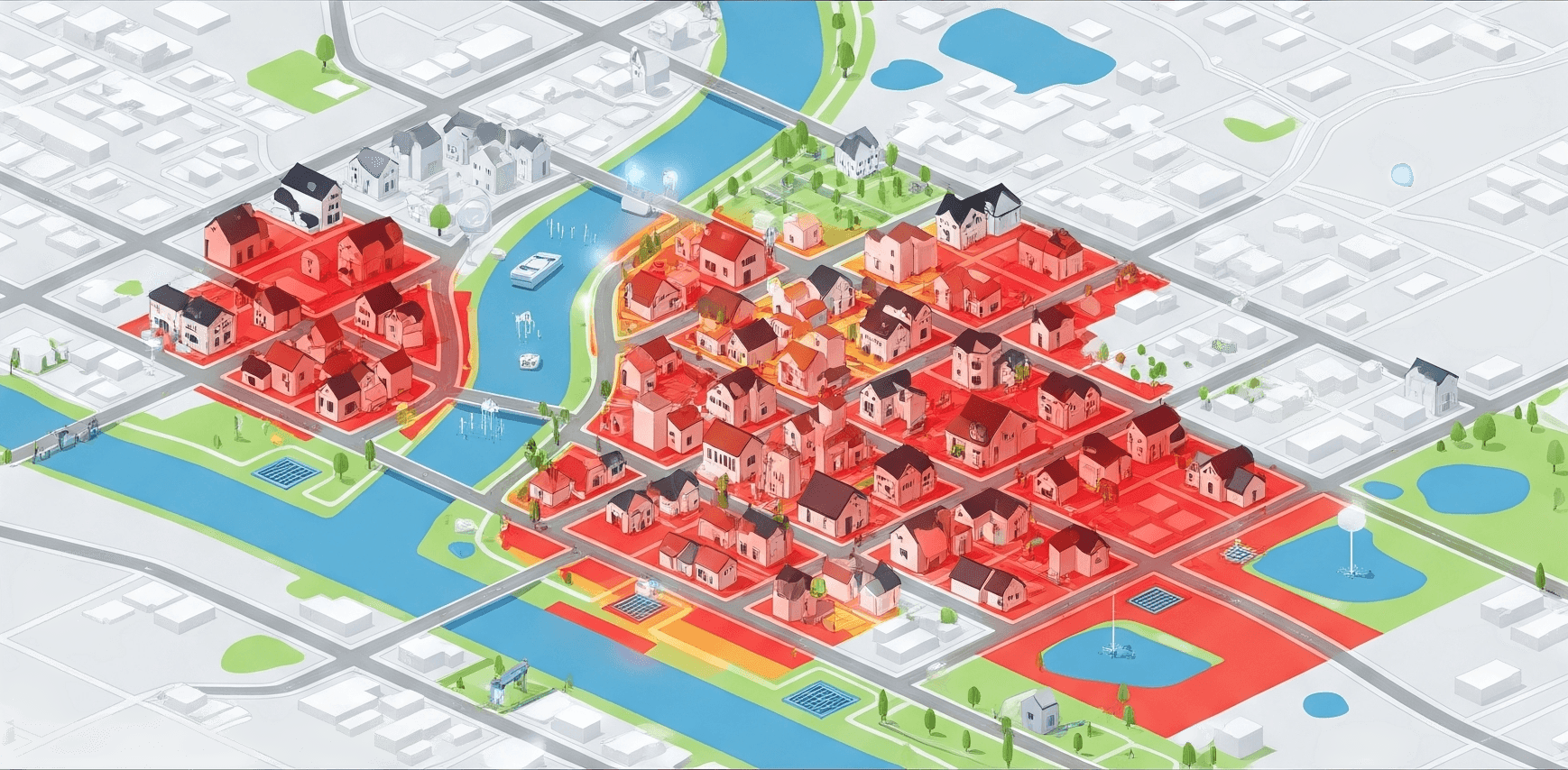
Stormwater modeling software looks like a crowded market and is really a small one. Most of the packages are environments built around one of a handful of engines, and the engine at the centre of the market, EPA SWMM, is free. The choice is less about which program computes the right answer and more about what you need around the engine: GIS, 2D surface flow, calibration tooling, and what your client or regulator expects to receive.
What is the best stormwater modeling software?
For most urban drainage studies the best starting point is EPA SWMM, because it is free, its engine is public, and regulators in the United States and many other countries accept its results without argument. The commercial packages earn their licence on workflow, on coupled 2D surface flooding, and on market expectations, not on getting a different answer from the same network.
That makes the useful question narrower: what does your study need that the free engine does not give you on its own?
Is EPA SWMM free?
Yes. The Storm Water Management Model is developed and released by the US Environmental Protection Agency at no cost, and it models rainfall runoff, pipe and channel hydraulics, storage and water quality in a drainage network. It is a complete tool on its own, and it is also the engine inside several commercial products.
Its limits are the interface and the scale of the work around it. Building a large network by hand, managing many scenarios and calibrating against a flow survey is slow in the bare program. We set out exactly where that line falls in PCSWMM vs EPA SWMM.
What PCSWMM adds
PCSWMM, from CHI, runs the SWMM engine inside a GIS based environment. What you buy is data handling, scenario management, calibration and sensitivity tools, and a 2D module for overland flow. The hydraulics underneath are SWMM's, which means a PCSWMM model can be handed to a reviewer who only has the free program.
It is the natural step up when a study has outgrown the bare engine but the client still expects a SWMM model.
When InfoWorks ICM is worth it
InfoWorks ICM, now from Autodesk, is built for integrated catchment modeling: the sewer network, the rivers it discharges to and the 2D surface it floods, in one model. It is the established tool for wastewater network models in the United Kingdom, where water companies maintain long lived catchment models and expect consultants to work in them.
It earns its cost on large combined systems, on studies where sewer and river flooding interact, and where the model is a corporate asset kept for years rather than built for one report. For a single development site it is usually more platform than the problem needs. Our InfoWorks ICM and WS Pro alternatives post covers what smaller teams use instead, and InfoWorks ICM vs TUFLOW covers the surface flooding side.
Where MIKE+ fits
MIKE+ is DHI's environment for collection systems and urban flooding, and the successor to MIKE URBAN. It couples the pipe network to DHI's 2D surface model and to the wider MIKE family, which matters when urban drainage is one part of a larger water system study. It is common in Europe, the Middle East and parts of Asia, and client familiarity in those markets is a legitimate reason to choose it.
Bentley, Autodesk site design, and TUFLOW
- SewerGEMS, CivilStorm and StormCAD are Bentley's drainage tools. They suit teams already working on Bentley's platform, where the drainage model sits alongside the rest of the design. StormCAD is for designing gravity storm sewers; SewerGEMS and CivilStorm handle dynamic analysis.
- InfoDrainage, from Autodesk, is aimed at site scale drainage design, including sustainable drainage features such as swales, ponds and permeable paving. It has taken over the role MicroDrainage long had in UK site design.
- XPSWMM grew from the same SWMM lineage and is also now owned by Autodesk alongside InfoWorks ICM and InfoDrainage. Check its current roadmap with the vendor before starting a long programme on it.
- TUFLOW is a 2D flood model first. It links a 1D pipe network to its 2D surface, and it is a strong choice where the question is overland flow paths across a large urban area rather than the pipes themselves.
How to choose
Work down the list. Is the model going to a US regulator, or to anyone who expects SWMM? Start with EPA SWMM, and move to PCSWMM when the workflow becomes the bottleneck. Is it a UK water company catchment? InfoWorks ICM, because that is where the existing model lives. Is the practice built on Bentley or on DHI? Stay there. Is it a single development site with sustainable drainage? A site design tool such as InfoDrainage. Is the question surface flow paths over a large area? A 2D model such as TUFLOW or ICM's 2D.
Licence terms and product ownership in this market change, so confirm the current position with each developer before a project depends on it.
What actually determines the answer
Drainage models are decided by their inputs. Pipe inverts and diameters from an asset register that has not been surveyed, rainfall that does not represent the design storm, and a model never checked against a flow survey will give a confident wrong answer in any of the packages above. The flow survey and the asset data deserve more of the budget than the choice of software.
Where the question moves from designing the network to operating it, with sensors and controlled storage, the software question changes too. We cover that in real time control vs detention.
Smart Bhujal runs urban drainage studies in EPA SWMM, PCSWMM and InfoWorks ICM, set out on our stormwater and drainage modeling page. If you are still deciding which package the study needs, that is a short conversation, and where the model has to become something an operator uses every day, it becomes a water decision support system.